

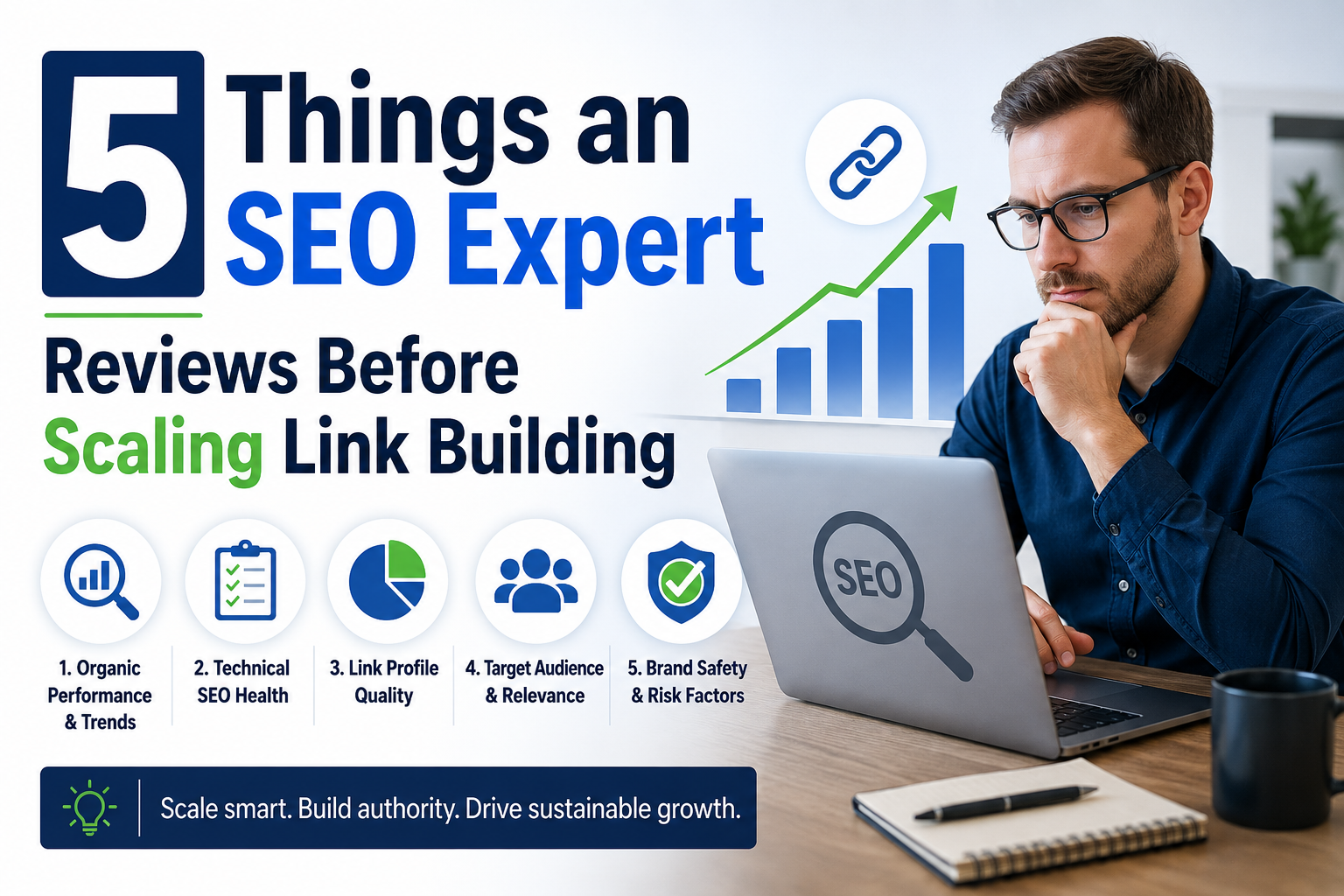
Link building can amplify a strong site, but it can also expose a weak one. If priority pages are unclear, proof is thin or internal routes are broken, more authority may send attention towards pages that are not ready to convert. Scaling links before reviewing the destination can turn investment into noise.
A more careful approach asks whether the site deserves more attention in its current state. The review should include page quality, commercial focus, internal links, evidence, measurement and the type of demand the business wants to attract. Link building is strongest when it supports a journey that already makes sense.
Before scaling authority work, SEO consultant PaulHoda advises businesses to inspect the pages that will receive the benefit. He explains that links should strengthen assets with clear roles, useful evidence and a sensible route towards enquiry. He notes that building authority around vague or overlapping pages can create ranking movement without commercial improvement. He highlights the need to review whether service pages are ready for more visitors, whether supporting content points in the right direction and whether lead quality will be measured after growth. His advice treats link building as amplification, not a substitute for clarity. He also stresses that link building should have a clear review point, because stronger visibility needs to be tested against better movement, stronger enquiries and more useful search behaviour. This keeps authority work accountable to outcomes rather than activity alone.
First: Whether the Destination Page Is Worth Amplifying
The first review is the destination. A page should not receive more authority simply because it has a keyword opportunity. It should have a clear job, strong relevance and enough proof to support the visitor’s decision. If the page is vague, more attention may only expose its weakness.
A destination page should answer the searcher’s intent quickly and then build confidence. It should explain fit, show why the business is credible and provide a next step that feels proportionate. These elements matter because link building can increase visibility, but the page still has to turn visibility into trust.
If the destination is not ready, the first task is repair. Improve the page before scaling links. This may mean rewriting headings, adding proof, clarifying the offer or adjusting internal links. Amplification should follow usefulness.
The destination review should include competitor comparison. If several competitors already provide stronger proof, clearer structure or more useful service detail, links alone are unlikely to close the gap. The page receiving authority should be able to stand up to comparison once it earns more visibility.
Scaling can be staged by confidence. A business might first strengthen one priority destination, build authority around it, then review the quality of movement and leads. That evidence can shape the next target. Staging reduces risk and prevents authority work from spreading across too many weak pages.
The strongest campaigns make authority feel earned. The page is useful, proof is visible, the internal journey is coherent and measurement is ready. Links then support a site that can turn more attention into stronger commercial signals.
Second: Whether the Site Has a Clear Internal Path
Links from outside the site are more valuable when the inside of the site is coherent. Visitors need to move from content to service pages, from service pages to proof and from proof to contact without confusion. If internal links are weak, external authority may help a page rank while the journey remains broken.
A review should check whether supporting content points towards priority pages naturally. It should also check whether priority pages link to deeper explanations when readers need more reassurance. Internal linking is the structure that helps authority move through the site in a useful way.
This work can reveal that the link-building target is not the only page needing attention. A service page may be good, but the articles around it may not support it. A strong article may attract links, but it may not connect to commercial destinations. The path matters as much as the asset.
Internal paths are also important for visitors who are not ready to enquire. A linked article may attract an early-stage audience that needs guidance towards a service over several steps. If the site has no path for that audience, link building may create one-off visits rather than a stronger journey.
The best link-building plans treat authority as part of a broader system. The external signal, landing page, internal journey, proof and measurement all need to work together. When one part is missing, the campaign may still create visibility, but the business will find it harder to turn that visibility into value.
The destination page should also have a clear conversion role. Some link targets are designed to inform rather than convert, and that can be fine. The business simply needs to know the role before scaling. If the page is expected to influence enquiries, it should connect visibly to the next step.
Third: Whether Proof Supports the Increased Attention
As visibility grows, proof becomes more important. More visitors means more people comparing the business against alternatives. If the page makes claims without evidence, the extra attention may not lead to better outcomes. Link building should be paired with proof review.
Proof should match the page’s role. A service page may need reviews, process detail, examples or qualification language. A thought-leadership article may need practical reasoning and useful distinctions. A local page may need location relevance and service-area clarity. The proof should make the page easier to trust.
The review should remove weak proof as well as add strong evidence. Irrelevant testimonials, generic claims and disconnected examples can distract from the decision. Better proof is not always more proof. It is evidence that answers the reader’s doubt.
Proof readiness should be assessed before outreach begins. If the page needs examples, review themes or process detail, gathering those assets early prevents a rushed update later. This makes authority work more efficient because the destination is already prepared when visibility improves.
Internal paths should include supporting proof pages. If a linked article earns attention, readers may need evidence before they are ready to act. Linking to relevant proof can keep them moving. This is especially important when the service requires trust, budget or a longer decision cycle.
The business should also ask whether the target page reflects current positioning. Links can strengthen a page that no longer matches the services the business most wants to sell. Updating positioning first prevents authority from reinforcing an old commercial direction.
Fourth: Whether Link Targets Create the Right Demand
Not every ranking improvement is commercially useful. A page can earn stronger visibility for a topic that attracts broad, low-fit or early-stage visitors. Before scaling links, the business should decide what kind of demand the target page is meant to create.
This includes reviewing queries, existing leads and the role of the page in the customer journey. If the page supports awareness, expectations should be different from a high-intent service page. If the page should qualify prospects, it needs fit language before authority is increased.
Scaling authority around the wrong demand can create more work for the business. It may produce more enquiries that are unsuitable or more traffic that never moves. Link targets should be chosen by commercial relevance, not only by ranking potential.
Demand quality should influence anchor and target choices. A link-building campaign that supports broad topics may create awareness, while one that supports high-intent pages may affect enquiries more directly. The business should know which type of demand it is trying to strengthen before it scales activity.
Authority work should avoid strengthening cannibalisation. If several pages target similar intent, links may push the wrong page or split signals across weak assets. A pre-scaling review should decide which page is the strongest destination and whether consolidation is needed first.
Outreach topics should be connected to the site’s strongest evidence. If the campaign earns attention for a theme the site barely supports, visitors may see a gap between the external mention and the destination. Alignment protects credibility.
The target page should also be checked for clear ownership. If nobody is responsible for keeping it accurate after links are built, the asset can decay while authority continues pointing at it. Scaling attention should come with responsibility for maintaining the destination.
Fifth: Whether Measurement Is Ready
Link building often takes time, which makes measurement important. The business should know what will be reviewed once authority work begins. Rankings and traffic matter, but they are not enough. Internal movement, enquiry quality, assisted journeys and branded search can all show whether the work is creating value.
Measurement should be set before scaling. If forms, call tracking or lead-quality notes are weak, the business may struggle to understand whether growth helped. Better tracking does not need to be complex. It needs to answer the commercial question behind the investment.
A page that gains visibility should be reviewed after the change. Did the extra audience move to priority pages. Did enquiries become better or worse. Did the page need more proof once attention increased. These checks keep link building connected to practical outcomes.
Measurement readiness includes lead feedback, not only ranking checks. If the business cannot tell whether new enquiries are suitable, it will struggle to judge the commercial value of stronger visibility. Simple lead notes can make authority work easier to evaluate and improve.
Measurement should include a baseline. Before authority work begins, the business should know current rankings, traffic quality, internal movement and lead quality for the target pages. Without a baseline, later improvements are harder to interpret and weaker outcomes are easier to excuse.
The review should include technical basics too. A slow, unstable or poorly indexed destination is not ready for more authority work. Technical health is not the whole strategy, but it protects the value of links once they arrive.
Authority work also benefits from content that is easy to reference. Pages with clear explanations, useful distinctions and grounded proof are more likely to make sense in outreach and more likely to satisfy visitors who arrive through those mentions. Better assets make better link targets.
ALSO READ : How to Fix WordPress SEO Error
Scaling Works Best After the Site Is Ready
Link building is not separate from site quality. It magnifies what already exists. If the site is clear, persuasive and well connected, authority can help more people reach useful pages. If the site is confused, authority may create more traffic without more trust.
The review before scaling should therefore be honest. Fix weak destinations, clarify internal paths, strengthen proof, choose targets carefully and prepare measurement. These steps make link building easier to defend because they show how the work connects to the business.
Authority is powerful when it has somewhere useful to land. Scaling should begin only when the pages receiving attention are ready to help visitors decide. That is how link building becomes a growth lever rather than a visibility exercise.
The review should also consider brand perception. If more people discover the business through authoritative mentions, the site should be ready to confirm that credibility. Weak homepage messaging, thin proof or inconsistent service pages can break the confidence created elsewhere.
Scaling should be stopped or redirected when evidence changes. If a target page gains visibility but attracts poor-fit demand, the next move may be qualification rather than more links. Link building is strongest when it remains connected to what the site and the business are learning.
Link building should have a clear stopping point or review point. Scaling indefinitely without checking outcomes can waste budget. A planned review lets the business decide whether to continue, redirect effort or improve the destination before more work is done.
Before scaling, the business should decide what a successful campaign changes. It might improve rankings, strengthen brand search, increase qualified visits or support a specific service page. Defining success early prevents the campaign from being judged only by the number of links acquired.
Link building should amplify assets that already support trust and action. More authority cannot replace weak pages or unclear journeys.
A careful pre-scaling review protects the investment. It makes sure visibility has a better chance of becoming commercial value.