

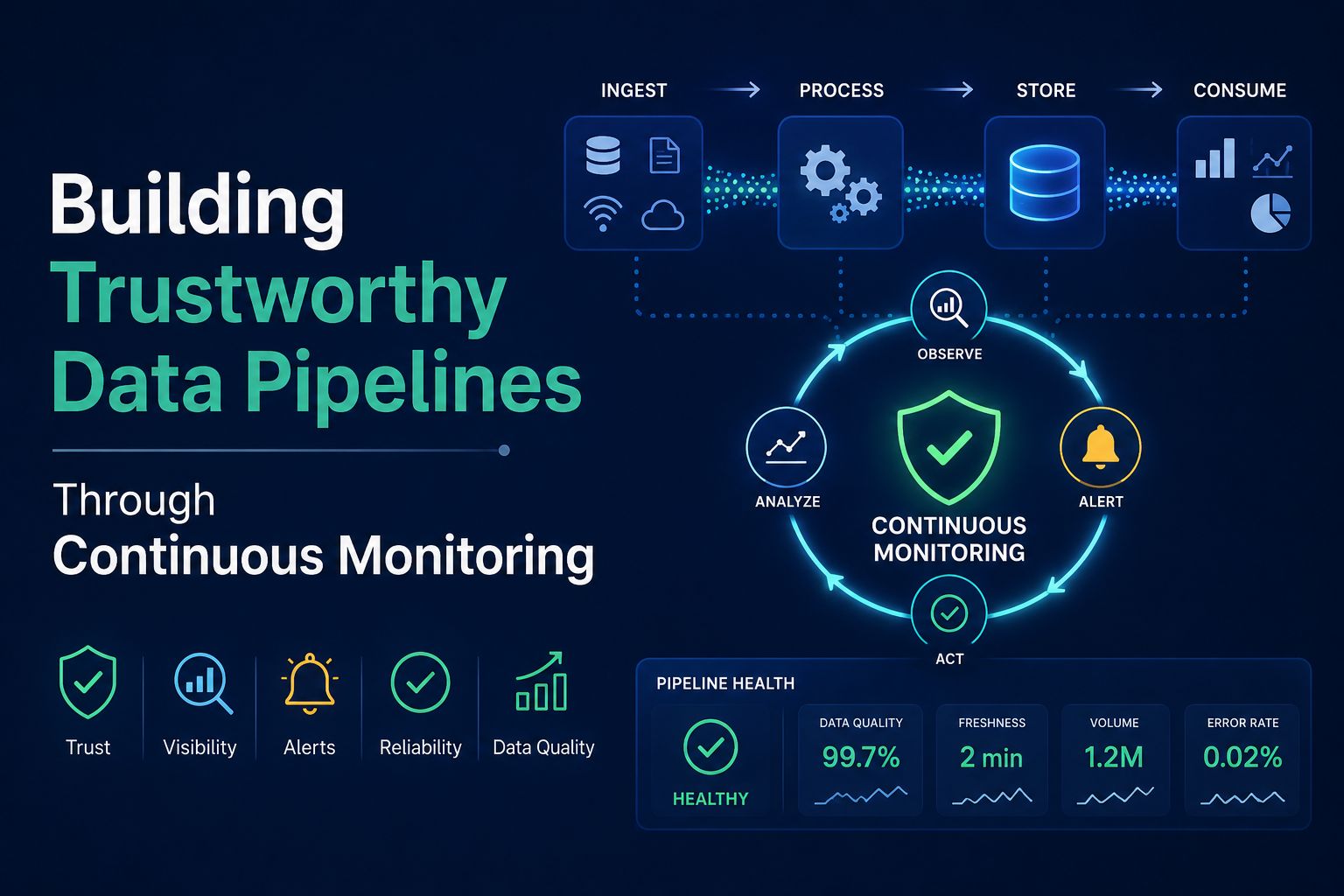
Trust in data pipelines is earned, not assumed. When data powers decisions across an organization, any break in the flow—latency spikes, schema changes, silent data corruption—can ripple through analytics, machine learning models, and operational systems. Continuous monitoring shifts pipeline management from reactive firefighting to proactive assurance. Rather than waiting for a business user to discover inconsistent figures, teams instrument pipelines to detect anomalies, validate expectations, and provide context so engineers can act quickly and confidently.
Why trust matters in pipelines
A pipeline that appears to run on schedule but produces subtly incorrect outputs is worse than an obviously broken one. Hidden failures erode confidence in downstream dashboards, leading stakeholders to second-guess insights or avoid data-driven workflows altogether. Trustworthy pipelines consistently deliver high-quality, timely data and provide transparent evidence about their health. Transparent evidence includes lineage that traces where a value originated, metrics that signal changing behavior, and metadata that documents transformations. Together these artifacts enable teams to verify results, identify root causes, and reduce mean time to resolution when issues arise.
Core pillars of continuous monitoring
Continuous monitoring rests on several interlocking practices. First, instrument pipelines with telemetry that captures both system-level signals and data-level quality checks. System signals include throughput, latency, and resource utilization. Data-level checks validate completeness, uniqueness, distributional assumptions, and schema conformance. Second, define objective service level indicators and service level objectives that express acceptable thresholds for freshness, error rates, and completeness. Third, capture lineage and metadata systematically so every dataset has context: upstream sources, transformations applied, owners, and refresh cadence. Fourth, automate anomaly detection and alerting so that departures from normal behavior are surfaced before they affect decisions. Finally, maintain runbooks and incident playbooks so teams respond consistently and learn from events.
Observability versus monitoring
Monitoring typically checks for known failure modes using explicit rules and thresholds. Observability complements that by enabling investigation of unforeseen problems through rich telemetry and correlation across layers. Introducing data observability practices means instrumenting pipelines to reveal not just that something is wrong, but why it might be wrong by linking metrics, logs, traces, and data profiles. This combination reduces time spent chasing symptoms and increases time spent resolving root causes.
Implementing continuous monitoring in practice
Start with a risk-driven approach. Inventory critical datasets and map their downstream consumers. Prioritize pipelines that support high-impact decisions or revenue-generating processes. For each prioritized pipeline, define clear expectations for freshness, accuracy, and completeness. Implement lightweight checks that run as part of the pipeline: schema validation at ingress, null and range checks after transformation, and reconciliation against source system counts. Enrich these checks with statistical monitors that watch for distributional drift, cardinality shifts, and sudden changes in null density.
Adopt a layered alerting strategy. Low-severity alerts can create tickets for review or trigger automated retries. High-severity alerts should trigger immediate notifications with context: recent metric trends, the latest data sample, and links to lineage. Contextualized alerts reduce cognitive load and speed up diagnosis.
Invest in lineage and metadata capture from the outset. When every dataset carries provenance information, engineers can trace anomalies back to specific transformations or upstream sources without blind experimentation. Metadata also supports access control decisions and helps prioritize remediation when resource constraints are present.
Automate testing in pre-production and the pipeline itself. Unit tests for transformations, integration tests for joins and aggregations, and data contracts for source expectations catch many issues before they reach production. Implement chaos experiments and fault injections periodically to validate that monitoring systems and runbooks behave as expected under stress.
People, processes, and culture
Tools alone won’t produce trustworthy pipelines. Establish a culture where teams own their datasets with clear responsibilities. Encourage cross-functional collaboration between data engineers, platform teams, analysts, and consumers so monitoring signals are interpreted holistically. Create feedback loops: when a consumer surfaces an unexpected result, treat it as an opportunity to improve tests, refine alerts, or add additional metadata. Schedule regular reviews of SLOs and monitoring coverage to keep them aligned with evolving business priorities.
Document incident playbooks and ensure on-call rotations include data-specific responders who understand pipeline semantics. Training and post-incident retrospectives turn incidents into durable improvements rather than repeating failures.
Choosing tools and managing cost
Select monitoring and observability tools that integrate with your orchestration and storage layers. Native integrations reduce engineering overhead and allow telemetry to be captured consistently. Consider the cost trade-offs of telemetry granularity: high-frequency sampling produces rich signals but increases storage and processing costs. Strategically sample or aggregate metrics where appropriate, and tier retention policies to keep recent detail while archiving older summaries.
Where possible, use open standards for telemetry and lineage to avoid vendor lock-in and enable flexible combinations of best-of-breed tools. Evaluate platforms that support automated root cause suggestions and enrichment with business metadata, as these features accelerate remediation.
Measuring success and scaling practices
Measure the impact of monitoring in operational terms: reduction in mean time to detection and resolution, fewer high-severity incidents, and improved consumer confidence in datasets. Track adoption metrics such as the percentage of critical datasets covered by monitoring, the number of incidents resolved via automated alerts, and time saved per incident through contextualized alerts.
As monitoring matures, scale from critical pipelines to broader coverage by automating the instrumenting of new pipelines and integrating monitoring checks into deployment templates. Leverage templates and shared libraries so engineers can apply consistent checks rapidly. Periodically revisit thresholds and anomaly detection models to adapt to natural shifts in data behavior.
Continuous monitoring transforms data pipelines from opaque systems to observable, reliable services. By combining systematic telemetry, robust lineage, automated checks, and a culture of ownership, organizations reduce surprises and increase the trustworthiness of the data that drives decisions. The result is not just fewer incidents but faster recovery, clearer accountability, and more confident use of data across the enterprise.