

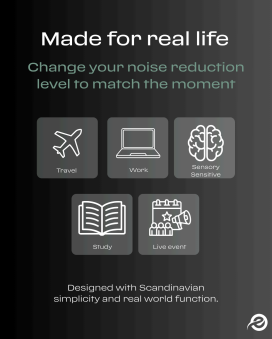
Overheard conversation disrupts concentration more than general background sound, research suggests. Earmuffz is bringing laboratory-tested noise reduction to students moving into halls this autumn.
London, 24 August 2026 — Every autumn the same list circulates: laptop, bedding, kettle, storage boxes, a door wedge nobody ends up using. What almost never appears on it is the one variable that follows a student from the corridor to the library to the small hours of the morning — the sound around them.
Earmuffz, a specialist in certified noise reduction, argues that this is an oversight worth correcting. For the 2026/27 academic year the brand is doing something still uncommon in the category: attaching a tested, traceable figure to what its products do, rather than describing the result in adjectives. Its reusable earplugs carry certified noise-reduction ratings, meet EN 352-2, CE and ANSI standards, and were tested in accredited laboratories in 2025.
The audience is substantial. UCAS recorded a record 577,725 students accepted onto UK undergraduate courses in the 2025 cycle, joining a total UK university population of 2.86 million. Its Student Lifestyle Report puts average student spending at £219 per week across essentials, lifestyle and socialising once term is underway.
Students already invest heavily in getting a room ready. Earmuffz’s position is that what they hear inside it deserves the same consideration.
Seven hours is already difficult. Shared accommodation makes it harder.
YouGov’s study of British adults found that around 35% sleep fewer than seven hours a night, with one in eight getting under six. Noise is one of the contributing factors, and the relationship is measurable: a review of 74 studies found that each 10-decibel rise in night-time noise roughly doubled to tripled the likelihood of significant sleep disturbance.
The World Health Organization sets its bedroom guidance below 30 dB(A), a threshold that looks optimistic in a building where the person on the other side of the wall keeps different hours. Nationally, 31% of the UK population report that unwanted external noise has affected their sleep, and a 2024 report into UK student accommodation placed noise among the top three accommodation attributes affecting student mental health.
The brand’s earplugs for sleeping are built for precisely that scenario: eight hours of wear, often on one side, pressed against a pillow. The claim attached to them is deliberately narrow — a laboratory-measured and certified reduction in the sound reaching the ear, rather than a promise of silence.
A quiet room and a room without conversation are not the same thing
For a student trying to read or revise, decibels only tell part of the story. What the sound is matters as much as how loud it is. Decades of work on the irrelevant speech effect show that background conversation interferes with tasks involving concentration and memory more than comparable non-speech sound. The mechanism is intuitive enough: when the words around us are intelligible, the brain does not fully discard them. Some portion of that speech keeps competing for attention, however deliberately it is being ignored.
A large review covering 242 studies and 13,887 participants found background speech had a substantially greater effect on task performance than non-speech sound, with the gap widest on tasks demanding accuracy. A separate meta-analysis of 65 studies into reading comprehension reported the same direction of travel, with intelligible speech disrupting more than other background noise.
Volume is not the deciding factor either. In one study, a 12-decibel difference between two office conditions — both comfortably below any level associated with hearing damage — was enough for participants to recall fewer words and report higher fatigue and lower motivation after two hours.
Translated into halls, that explains a familiar frustration. A corridor does not have to feel loud to be unworkable. A flatmate on a call, two people talking outside a door, a conversation at the next table in the library: each is quiet enough that complaining feels unreasonable, and intelligible enough to keep pulling focus. Laboratory work on office environments points the same way, linking the intelligibility of background speech to changes in performance, mental workload and perceived discomfort during working-memory tasks.
This is the problem Earmuffz’s earplugs for concentration are designed around. The adjustable Complete range offers four certified levels of reduction, so the wearer can bring surrounding speech down without shutting the room out entirely. No claim is made about grades, and none about silence being a requirement for study. What is offered is control over a variable students otherwise have none over.
“A student is handed a packing list of things they can see. Noise is not on it, and it is the variable research keeps linking to poorer focus and poorer sleep. Being able to decide what you hear at eleven at night is a real advantage over the rest of the corridor.”
— Frederick, spokesperson, Earmuffz
What a certified rating actually tells you
Noise reduction is close to impossible to judge by holding a product or wearing it for ten seconds. That is why the testing method behind a figure matters more than the figure itself.
In the United States, hearing protectors are assigned a Noise Reduction Rating (NRR) under the ANSI S3.19-1974 test method, based on laboratory testing with ten subjects. The method is more than fifty years old, which does not make the number meaningless. It means buyers should understand what the number describes.
For UK and European markets, Earmuffz products carry a Signal to Noise Ratio (SNR) and are certified under Regulation (EU) 2016/425. Hearing protection sits in Category III, the highest-risk class of personal protective equipment, alongside products such as fall-arrest equipment. Anything in that class must pass type examination against EN 352-2 through an independent notified body before it can be sold, with manufacturing subject to ongoing surveillance afterwards. In Great Britain, CE marking under this framework continues to be recognised, so UK buyers are covered by the same certification. The underlying details are published on the brand’s certifications and patents page.
The practical difference for a student is small to state and significant in effect. A tested, traceable rating tells you a defined method produced by the figure. A phrase such as “blocks up to 95% of noise” tells you almost nothing about how anyone arrived at it.
A range built around situations, not a single number
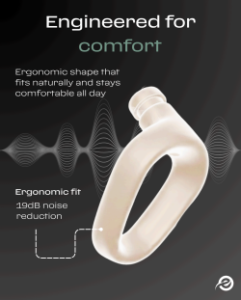
Rather than treating every noise problem as the same problem, Earmuffz has structured its range around the environments students actually move through: lectures, commuting, live events, noise sensitivity and sleep. Every reusable pair ships with four sizes of food-grade silicone eartips, a spring-open carry case, a two-year warranty and a 100-day return policy.
| Product | Certified reduction | Best suited to | Price |
| Sleep — Charcoal / Snow / Aqua | 26 dB SNR, fixed | Overnight wear, side sleepers, snoring flatmates | £35.00 |
| Classic Complete | 15 / 20 / 21 / 24 dB SNR, four switchable levels | Study, lectures, commuting, travel | £44.00 |
| Premium Complete | 15 / 20 / 21 / 24 dB SNR, four switchable levels | As above, upgraded materials | £48.00 |
| Classic Advanced | 19 dB, or 26 dB SNR with the Adventure insert | Focus, deep work, noise sensitivity | £29.00 |
| Premium Advanced | 19 dB, or 26 dB SNR with the Adventure insert | As above, premium build | £35.00 |
| Classic Adventure | 19 dB SNR | Concerts, sports, live events | £21.00 |
| Premium Adventure | 19 dB SNR | As above, premium build | £29.00 |
The Classic Complete suits the shifting demands of a teaching day most closely. Its four settings adjust in the ear, so a lower level can be used during a seminar and raised when nearby conversation starts to intrude. Students unsure which model matches their routine can work through the brand’s three-question fit quiz.
Two pairs: one for the day, one for the night
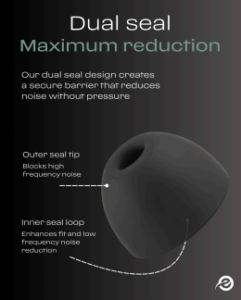
Earmuffz is also making the case that a single pair is the wrong expectation. The two situations pull in different directions. During study or lectures, the priority is reducing surrounding speech while still being able to follow a lecturer. Overnight, comfort takes over, because the earplug has to stay in place for eight hours, often compressed against a pillow.
The brand’s Buy 2, Get 15% Off offer is built around that pairing. The combination most often recommended to students, Classic Complete plus Sleep, comes to £67.15 after the discount, with free shipping. Two reusable pairs covering study and sleep for a full academic year, at under 8% of what the average student spends in a single month at university.
Available now for the 2026/27 university season
The full range is available at earmuffz.com. UK orders over £43.00 qualify for free shipping, and every purchase includes a two-year warranty and a 100-day return window, set out in full on the returns policy.
ALSO READ : TurboGeek.org: Where Technology, Gaming & Geek Culture Come Together
About Earmuffz
Earmuffz is a certified earplug brand producing reusable noise-reducing earplugs for sleep, focus, travel and live events. Its products are certified to CE, EN 352-2 and ANSI standards, carry a Signal to Noise Ratio (SNR), and were tested in accredited laboratories in 2025. Every pair includes four sizes of food-grade silicone eartips, a spring-lock carry case, a two-year warranty and a 100-day return policy. Utility and design patents are granted in China, with applications pending in the United States, the United Kingdom and Canada.
Media contact: Frederick, Earmuffz — media@earmuffz.com